Extreme Emission Line Galaxies
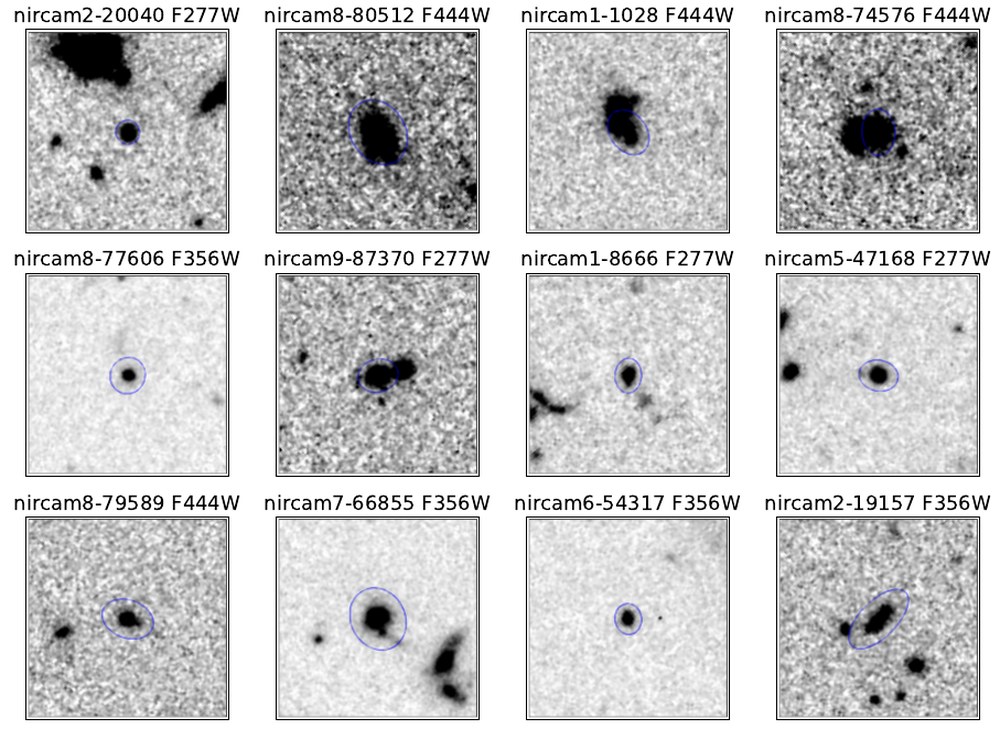
Extreme Emission Line Galaxies (EELGs) At Cosmic Dawn
I study extremely high equivalent width (EW) rest-optical lines (H$\alpha$, [OIII]$\lambda5008,4960$) in galaxies up to cosmic dawn and through the epoch of reionization. Specifically, I am interested in how we can measure theses lines from the broadband photometry in JWST deep field images. In the first days of CEERS, the field consisted of seven broadband filters from JWST and the legacy HST coverage from CANDELS. The discovery space was largely unknown, but many early galaxies (4<z<9) should have less evolved ISMs and therefore strong rest-optical emission of Ha + [NII] and/or Hb + [OIII] driven by recent star formation or active galactic nuclei (AGN) activity. I employed a flux-excess defined equivalent width (EW) selection in the observed-frame to remove any possible biases introduced by SED fitting and identified ~1100 EELGs in CEERS. My work demonstrated that EELGs were more numerous than in the nearby universe, were consistent with low-metallicity, high-ionization parameter MAPPINGS V models (photo-ionization models), and varied in emission line morphology. This selection of EELGs independently of SED fitting also identified a class of sources that were missed by SED fitting which was placing them at redshifts ~4x lower than their true redshift, directly tied to the coverage from medium-band photometric filters.
My photometric EELG catalog has provided target selections for several spectroscopic surveys (OCEANS, THRILS, and CEERS). Many other spectroscopic programs also targeted these EELGs in the CEERS field and I compiled a master catalog across the RUBIES, CAPERS, and THRILS surveys, in addition to the original CEERS spectroscopy, to evaluate the performance of photometric EELG identification . I demonstrated that recovery of line broadening, which signposts AGN activity, was directly tied to survey depth and that many EELGs hosted AGN. However, the EELGs with AGN either had falsely boosted EWs from sources with red optical continua but blue UV continua (i.e.: those with LRD-shaped energy distributions) or were consistent with composite systems. The EELGs without AGN and composite systems both showed no strong evidence for AGN dominated emission, with no high-ionization line detections in individual sources or stacks. The true EELGs, with and without broad-line AGN, were consistent with the same regions of line diagnostic diagrams which implied low metallicity, high ionization conditions and had similar emission line morphologies. This implied the same processes were driving the extreme emission in EELGs with and without AGN components.
This work motivated an observing proposal to add medium bands to the CEERS field of view, my SPAM proposal detailed in the observing design tab.
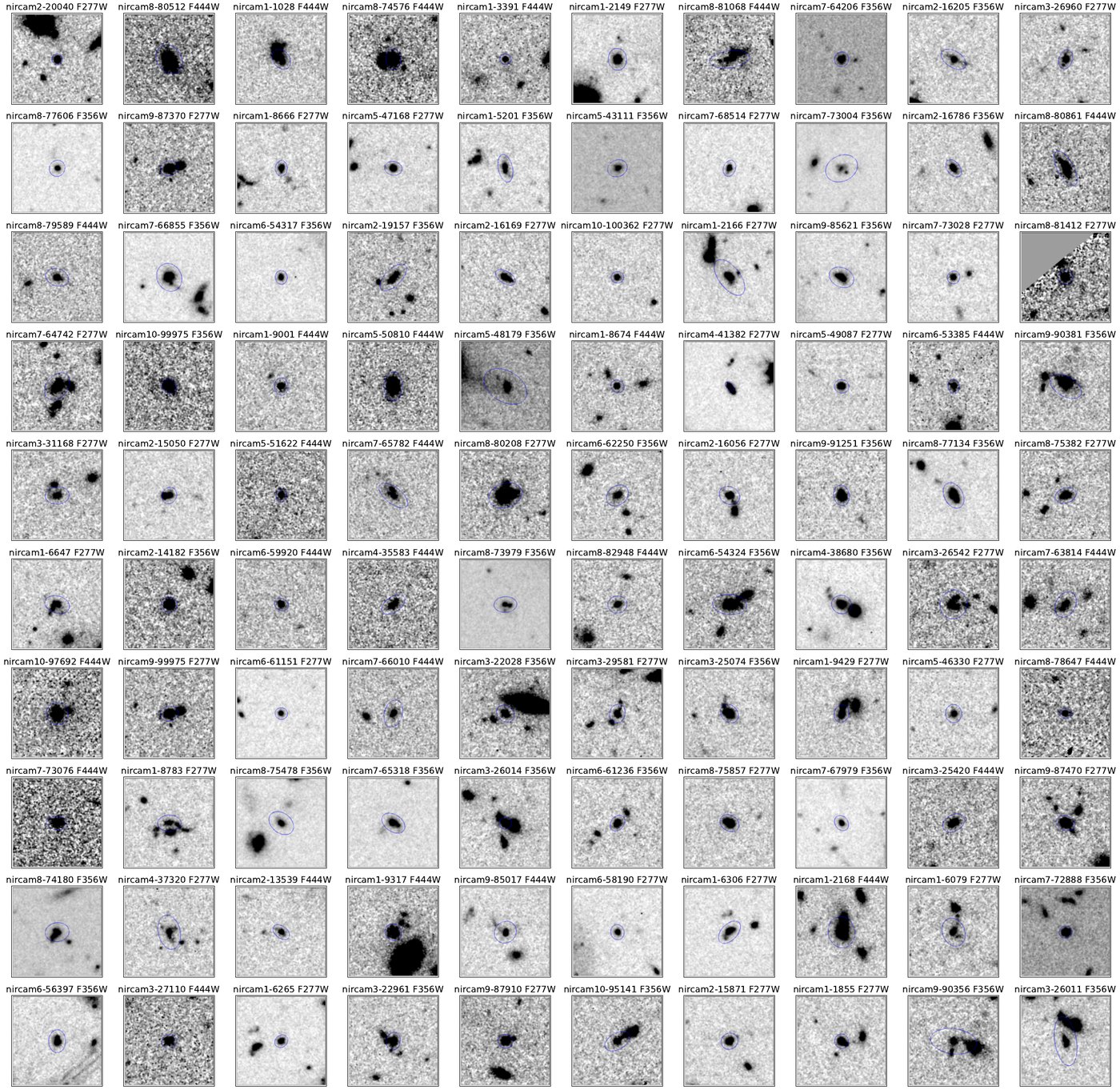
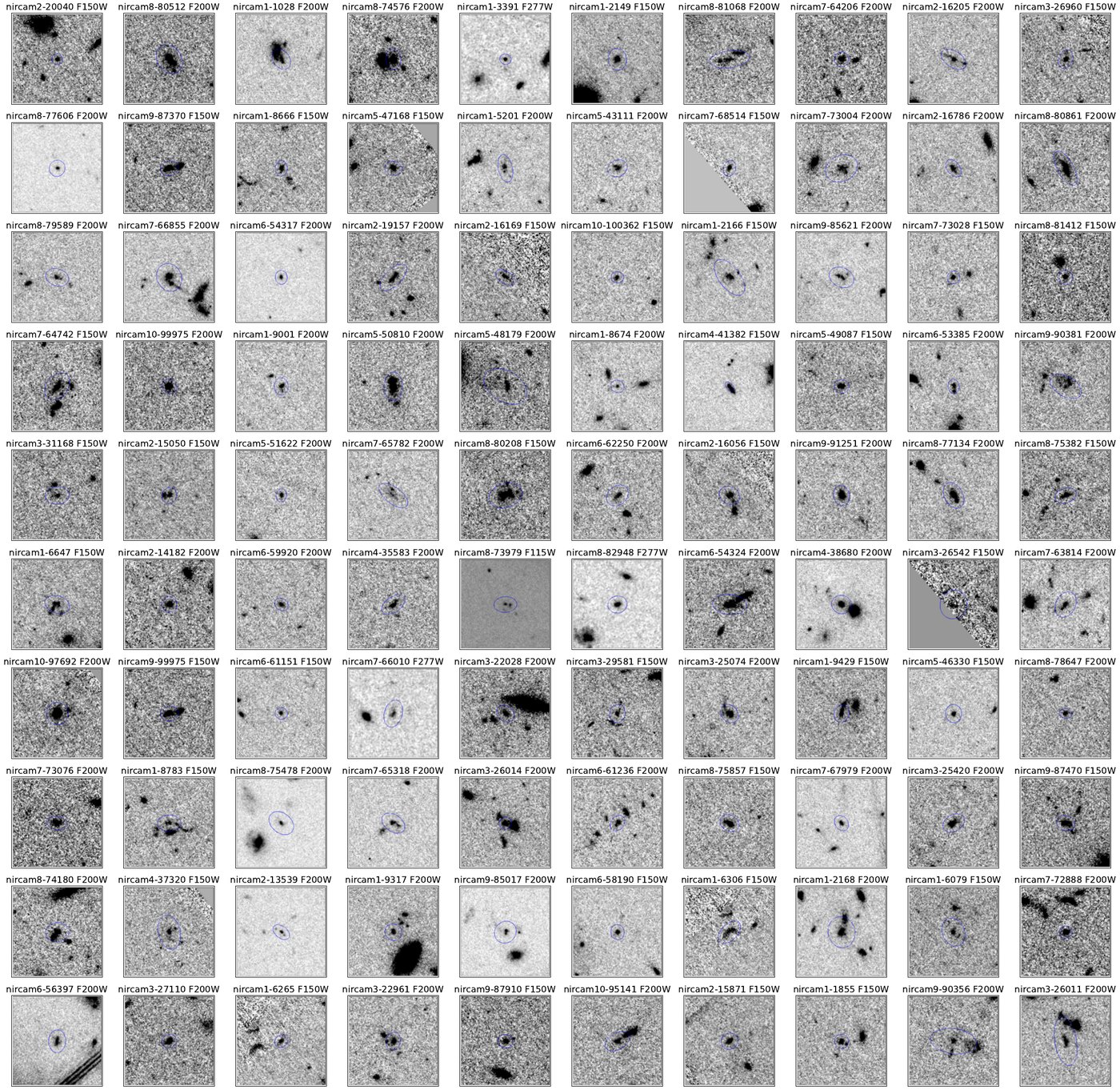
Full-resolution versions: line bands and continuum bands.
Papers I led
Papers I contributed to
- Extreme equivalent-width-selected low-mass starbursts at z = 4 − 9: Insights into their role in cosmic reionization
- A Morphology Catalog of Galaxies in CEERS: Evolution in the Size and Color Gradients of Galaxies Since Cosmic Dawn
- THRILS -- The High-(Redshift+Ionization) Line Search: Program Description & Redshift Catalog
- Testing Photometric Techniques for Measuring the Rest-frame UV Spectral Slope against JWST PRISM Spectroscopy
- Optical Strong Line Ratios Cannot Distinguish between Stellar Populations and Accreting Black Holes at High Ionization Parameters and Low Metallicities
- Emission-line Diagnostics at z > 4: [O III]λ4364/Hγ versus [Ne III]λ3870/[O II]λ3730
- Little impact of mergers and galaxy morphology on the production and escape of ionizing photons in the early Universe
- CAPERS Observations of Two UV-bright Galaxies at z > 10. More Evidence for Bursting Star Formation in the Early Universe
- The Cosmic Evolution Early Release Science Survey (CEERS)
- Physical properties of extreme emission-line galaxies at z ∼ 4─9 from the JWST CEERS survey
- Peering into cosmic reionization: Lyα visibility evolution from galaxies at z = 4.5-8.5 with JWST
- The Complete CEERS Early Universe Galaxy Sample: A Surprisingly Slow Evolution of the Space Density of Bright Galaxies at z ∼ 8.5─14.5
- CEERS Key Paper. VIII. Emission-line Ratios from NIRSpec and NIRCam Wide-Field Slitless Spectroscopy at z > 2
- First Look at z > 1 Bars in the Rest-frame Near-infrared with JWST Early CEERS Imaging