Little Red Dots
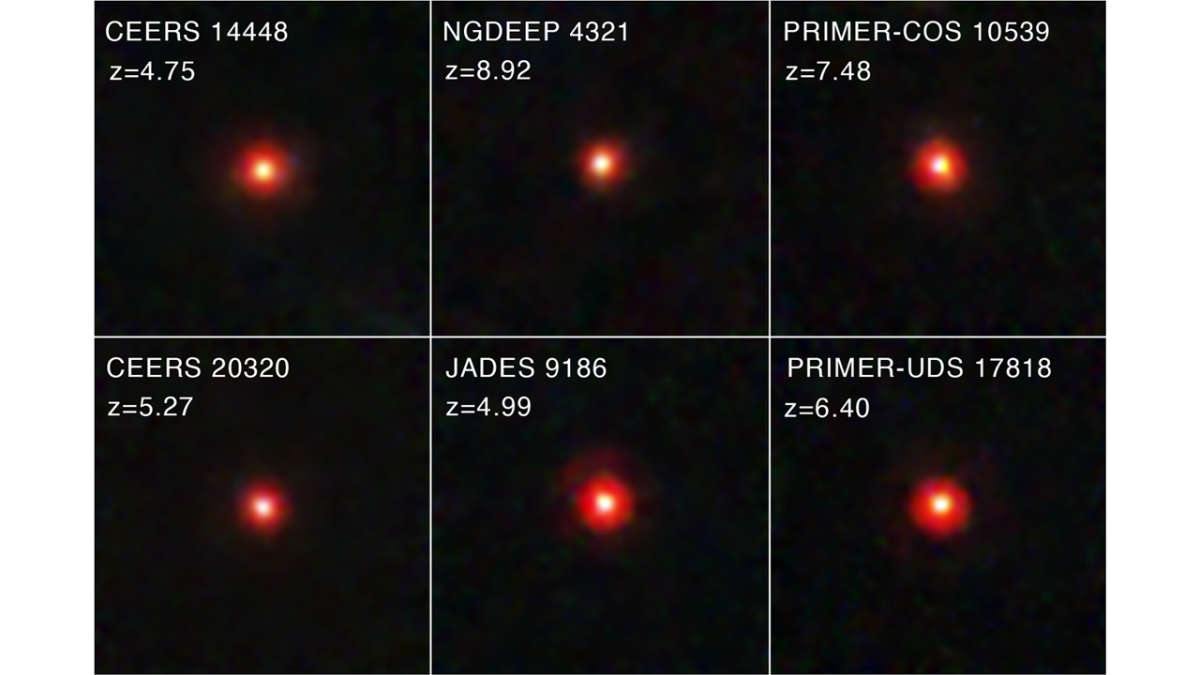
Little Red Dots in the CEERS Field of View
Little red dots (LRDs), the mysterious compact objects with v-shaped energy distributions in the early Universe, gained and rose in popularity during my dissertation work. I commented on their contamination in EELG samples, particularly driven by a lack of medium-band photometric filter coverage in the rest-optical, in my EELG paper on spectroscopic coverage, “Extreme Emission Line Galaxies in CEERS are Powered by Star Formation, not AGN.” Most of my LRD work comes from my work with the OCEANS collaboration and supervisory work with my junior mentees.
I am a key contributor to the OCEANS program (program ID 8410, PI: R. Simons) which aimed to census the outflow kinematics of galaxies in CEERS using high-resolution (R~2700) spectroscopy. This coverage revealed line shapes with absorption features in four of the ten targeted LRDs. I showed these were consistent with significant amounts of excited (n=2) hydrogen with typically slow (~ 100s km/ s) outflow velocities. One source puzzlingly had kinematic differences between H$\alpha$ and H$\beta$ absorption. I built a qualitative model where the kinematic offsets could be attributed to absorbing gas co-located with emission regions. I further demonstrated that the continuum colors, which may trace either Balmer break strengths or black body temperature, relate to outflow speeds. This points to differences in LRDs which reflect different system phases, where amount of available gas changes outflow speeds, or differences in viewing angle, where some lines of sight have different amounts of available gas and this drives differences in outflow speeds and non-uniform geometry. The two cases are degenerate and resolution is a critical step in building a full picture of LRDs.
Papers I led
Papers I contributed to
- The THRILS Factor: Investigating the properties of Little Red Dots (LRDs) at 3<z<6 with JWST/NIRSpec
- Skyfire: A Spectroscopic Census of Little Red Dots and Broad-Line AGN in the CEERS Field
- Ripples in the OCEANS: Broad Line Variability of Little Red Dots
- The quasi-star model for Little Red Dots: potential and challenges
- Beyond the Monsters: A More Complete Census of Black Hole Activity at Cosmic Dawn
- Little Red Dots: One Photometric Tag Concealing Diverse Spectroscopic Flavors of Massive Star Formation and Black Hole Activity
- CAPERS-LRD-z9: A Gas-enshrouded Little Red Dot Hosting a Broad-line Active Galactic Nucleus at z = 9.288
- Here There Be (Dusty) Monsters: High-redshift Active Galactic Nuclei Are Dustier than Their Hosts
- Broad-line AGNs at 3.5 < z < 6: The Black Hole Mass Function and a Connection with Little Red Dots
- The Rise of Faint, Red Active Galactic Nuclei at z > 4: A Sample of Little Red Dots in the JWST Extragalactic Legacy Fields
- Extremely Red Galaxies at z = 5─9 with MIRI and NIRSpec: Dusty Galaxies or Obscured Active Galactic Nuclei?